
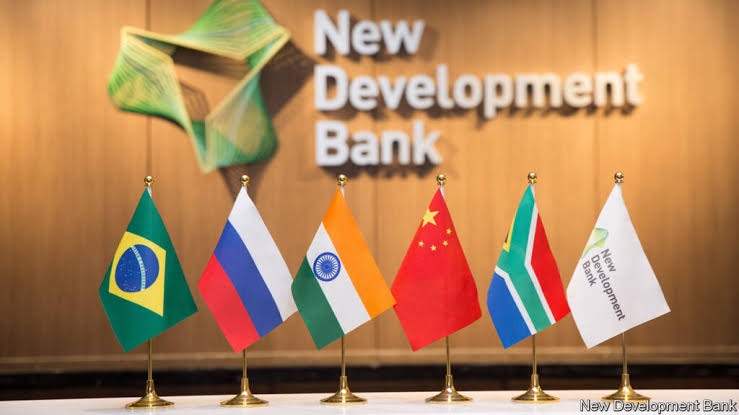
The New Development Bank (NDB), often called the BRICS Bank, is gaining attention as BRICS nations look to strengthen their role in the global financial system. But what exactly is it, and why does it matter? Let’s answer the most common questions.
1. What is the New Development Bank (NDB)?
The NDB is a multilateral development bank set up in 2015 by the BRICS countries—Brazil, Russia, India, China, and South Africa—to finance infrastructure and sustainable development projects.
2. Why was the NDB created?
It was created as an alternative to Western-dominated institutions like the World Bank and IMF, giving emerging economies more control and a voice in global finance.
3. Who are the members of the NDB?
The founding members are the five BRICS nations. Over time, other countries like Bangladesh, the UAE, Egypt, and Uruguay have also joined.
4. Where is the NDB headquartered?
The NDB’s headquarters is in Shanghai, China. It also has regional offices, including one in South Africa.
5. How much capital does the NDB have?
The bank started with an initial authorized capital of $100 billion, funded by contributions from BRICS members.
6. What kind of projects does the NDB fund?
The NDB focuses on infrastructure, renewable energy, transport, clean water, urban development, and sustainable growth projects.
7. Does the NDB lend only to BRICS countries?
No, while BRICS countries are the primary beneficiaries, the NDB also lends to other developing nations that become members.
8. How is the NDB different from the World Bank or IMF?
Unlike the IMF, the NDB doesn’t impose strict policy conditions on loans. It’s also structured to give equal voting rights to BRICS members, unlike the World Bank, where voting power depends on financial contributions.
9. What currency does the NDB use for lending?
The NDB aims to increase the use of local currencies (like rupees, yuan, rubles) instead of relying only on the US dollar, reducing exchange rate risks for borrowers.
10. Why does the NDB matter for the future?
The NDB represents the rise of emerging economies in global finance. If it grows stronger, it could gradually reduce dependence on Western institutions and the US dollar system.
The New Development Bank is still young compared to the World Bank or IMF, but it symbolizes a shift in global financial power. For BRICS and beyond, it’s not just about money—it’s about shaping a new world order in development finance.